
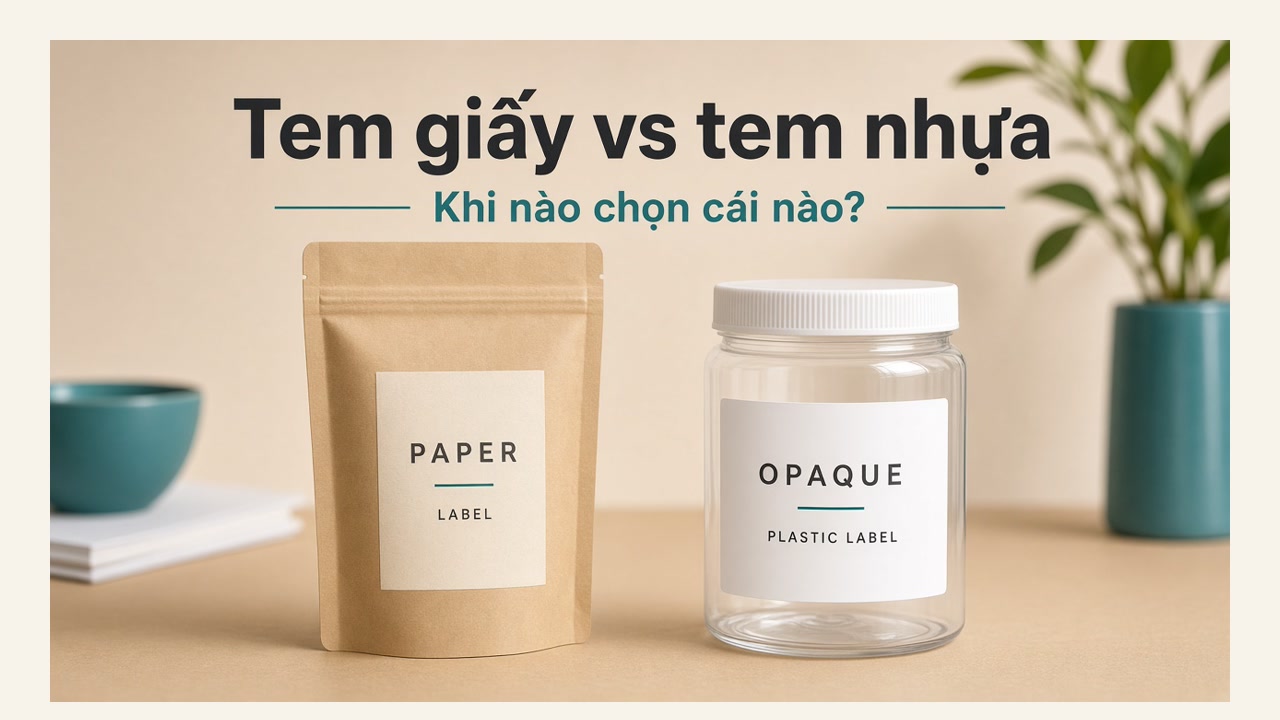
Paper vs plastic labels: when to choose which?
Head-to-head on cost, durability, surfaces, and fail cases — when paper is enough, when plastic is worth it, plus a checklist before you order.
The two most common label materials — paper and plastic (PVC / PP / PET) — are often chosen by habit: “last time we printed paper, so paper again,” or “that other shop’s labels look glossy, so order plastic.” Results: stickers peel on humid zip bags, ink bleeds on jars in the fridge, or the opposite — paying for plastic on dry carton that never needed it.
This article is a head-to-head on cost, durability, application surfaces, and common fail cases. Goal: know when paper is enough, when plastic is worth it, and when to briefly consider clear labels as a third option. The framework works for retail, fashion, cosmetics, education, mother & baby, events, and grocery — not locked to F&B alone.
For a three-type overview (paper / plastic / clear), start with Choosing label materials: paper, plastic, or clear?.
Quick compare: where paper and plastic differ
CriterionPaper labelsPlastic PVC/PP/PETWaterproof / humidityNoYesOil / wipeable surfacesWeakClearly betterGrip on rough surfaces (kraft, coarse paper)GoodGoodGrip on glossy surfaces (glass, PET, foil)Peels / looks temporaryMore stableImpact / shipping durabilityEdges tear easierHigher“Premium” feel on bottles / jarsMediumHigher (especially with laminate)Relative costLowestAbout 1.5–2× paper at same sizeSmall runs / SKU testsVery sensibleSensible when waterproofing is required
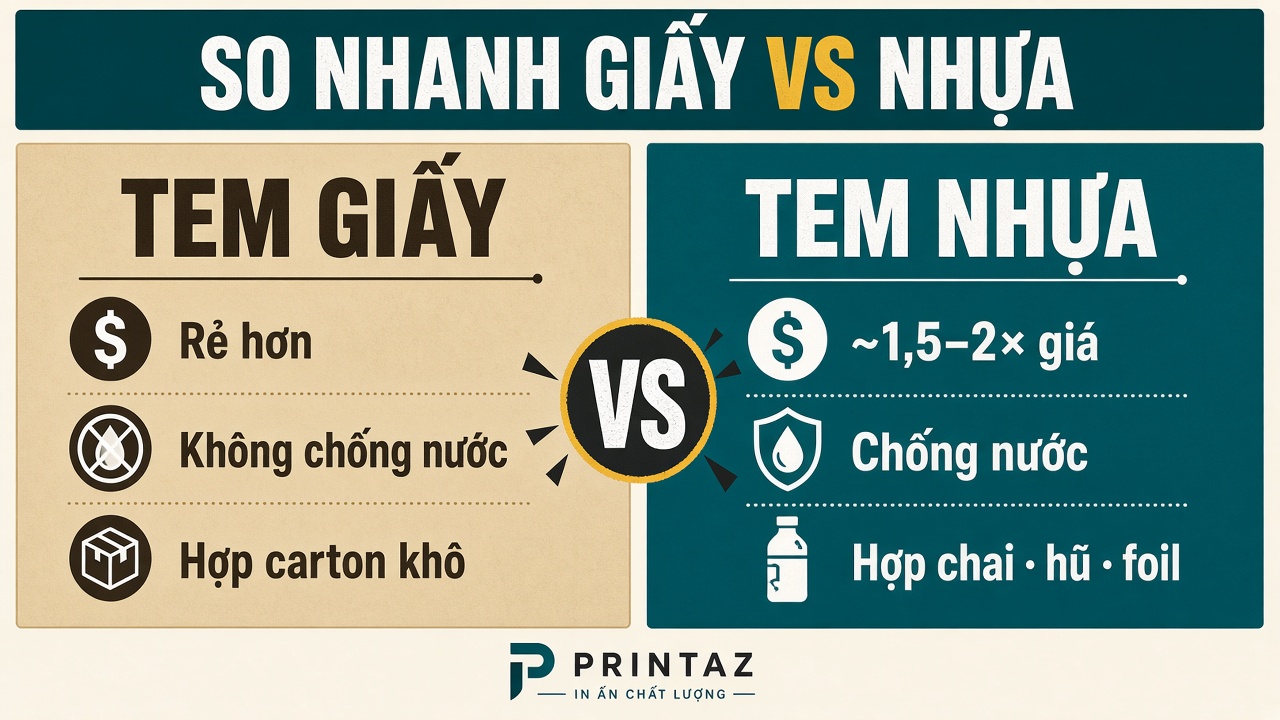
No public unit prices in this article — the 1.5–2× figure is directional by material. For concrete numbers by size and quantity, use the Báo giá / quote CTA.
When paper is enough (and smart)
Paper wins when the environment is dry and the surface fits. Typical situations:
Carton boxes / kraft bags / paper packaging for dry goods (fashion accessories, books / learning materials, dry snacks, indoor event gifts).
Fun die-cut stickers for short campaigns, pop-ups, customer gifts — many shapes, fast artwork changes.
Logo, layout, and brand-color tests on paper packaging before locking a long-term version.
Tight budget and you are sure the product will not meet water, freezer condensation, oils, or bathrooms.
Strengths: low cost, fast small runs, flexible die-cuts, good kraft grip. Right-place paper beats “plastic everywhere to be safe” on dry SKUs.
Hard limit: not waterproof. Ice packs, wet shipping cartons, damp hands — wrinkle, bleed, peel. Wrong material, not a print defect.
When plastic is worth the upgrade
Move to plastic when environmental risk outweighs the price gap. Clear signals:
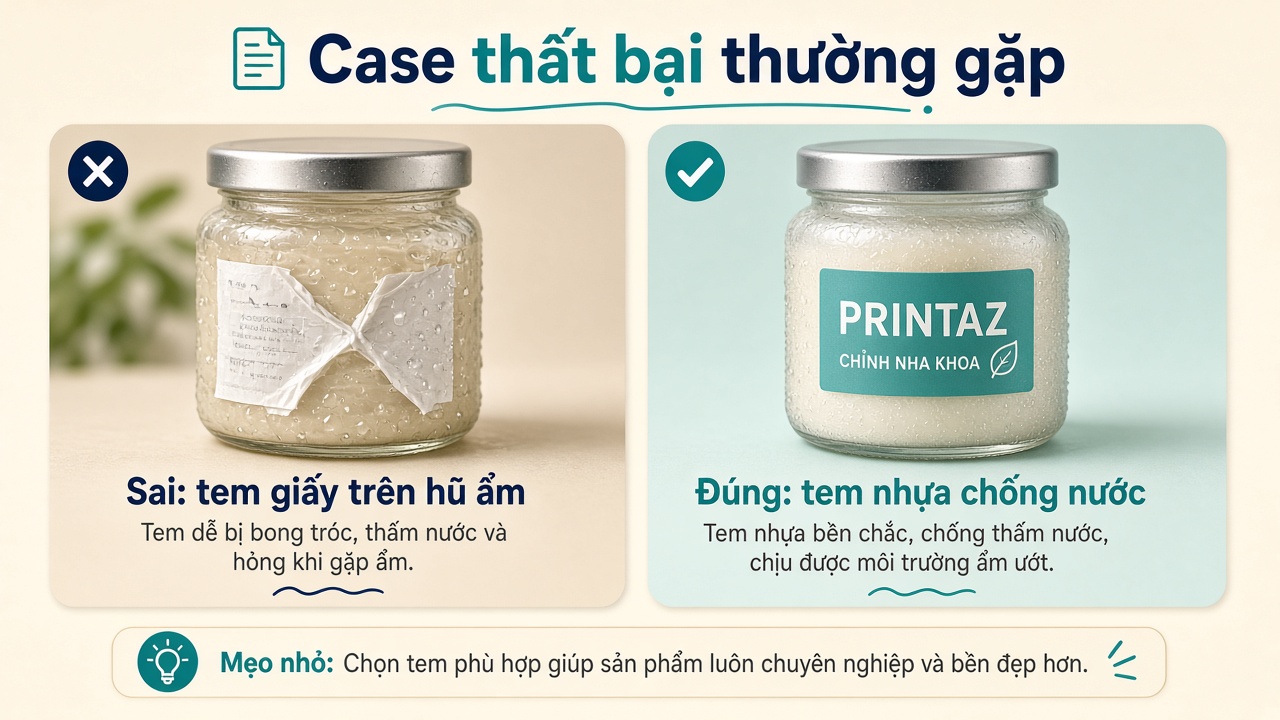
Packaging is glass jars, glossy plastic bottles, foil pouches, glossy zip bags.
Products go into fridges / freezers, cool rooms, or humid retail chains.
Cosmetics, shampoo, mother & baby — surfaces often get water or oil and need wiping.
Labels must survive carton friction, stacking, or customers peeling and reapplying.
Strengths: waterproof, stronger multi-surface adhesion, sharp color, optional gloss/matte laminate. Long shelf or shipping — laminate often beats a full reprint.
Cost: about 1.5–2× paper at the same size. Some traditional printers require MOQ; Printaz has no MOQ — from 1, so trial a few dozen on the real bottle/jar before scaling.
Common fail cases (and how to avoid them)
Paper on glass jars in the fridge → condensation + paper adhesive = peeled edges and ink bleed. Fix: plastic or clear; consider laminate.
Paper on foil / glossy zip pouches → slick surface, temporary look, easy slip. Fix: plastic; test adhesive on the exact pouch type.
Expensive plastic on dry indoor carton → paying more with no customer-facing gain. Fix: die-cut paper is enough; reserve plastic budget for humid / glossy SKUs.
Clear plastic without contrast / white underprint → light text “disappears.” Fix: design contrast first; ask for white underprint when needed.
Locking price before locking surface → reprint orders. Fix: surface → environment → budget.
Clear labels: the third option (briefly)
Clear labels sit in the waterproof / durable group like plastic, but the main goal is aesthetics: show the product or box artwork behind the label. Fit glass jars, clear bottles, mica. Remember: light text and logos often need a white underprint; design must treat the product behind the label as part of the visual.
Do not choose clear only because it “sounds premium” if you actually need a solid color block covering the area — opaque white / solid plastic labels read information better in that case.
Checklist before you order
Print or save this note — tick before submitting:
[ ] Confirmed the real application surface (paper / kraft / glass / PET / foil / mica)?
[ ] Will the product meet water, humidity, freezing, or oil?
[ ] Is this a test run or a long-term stable SKU?
[ ] Budget priority: cheap (paper) or durable (plastic / clear)?
[ ] Need gloss / matte laminate?
[ ] Need a special die-cut for easy peel-apply?
[ ] If clear: planned contrast + white underprint?
[ ] Quantity this time — small trial first or full run? (Printaz accepts from 1 order, no MOQ.)
[ ] Reviewed layout on mockup / 3D? (Mockups help layout — not a color soft-proof.)
If most answers lean “dry + paper + test” → paper. If two or more signals are humid / glossy / cold → plastic. Want the product visible → consider clear.
Offset, digital, laminate — after paper vs plastic
Material first, print method second: high stable volume → offset; small / campaign runs → digital or moderate rolls. Laminate for heavy handling, carton friction, or consistent matte/gloss on shelf.
Design and order on Printaz
No specialized desktop software. On Printaz pick a die, edit 2D, preview 3D / mockup, order — no MOQ. Mockups help layout, not a color soft-proof. Numbers by size / material / quantity → Báo giá.
Closing
Paper fits dry kraft/paper packaging, tests, short campaigns. Plastic is worth it for water, humidity, cold, oil, or glossy surfaces — the ~1.5–2× gap usually beats a reprint. Clear is the aesthetic waterproof option, not a default upgrade for every SKU.
Bắt đầu miễn phí on printaz.vn · Báo giá: [email protected].
Share this article