
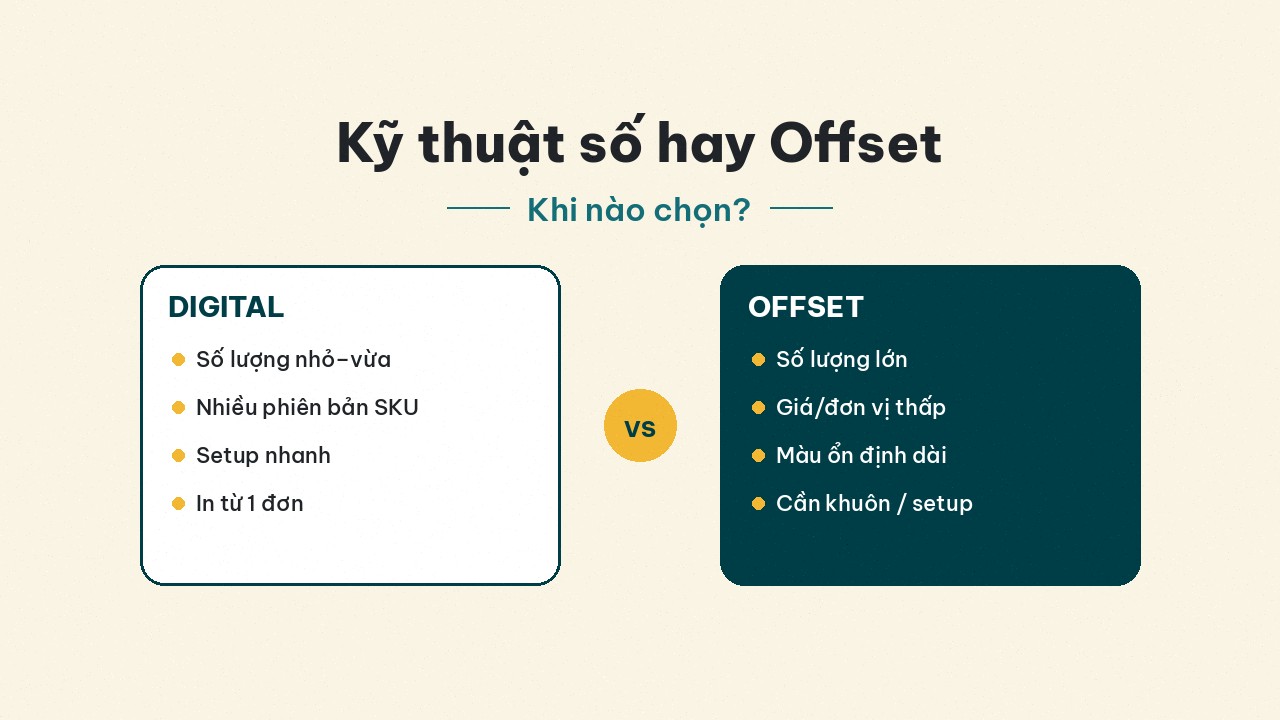
Digital vs offset printing: when should shops and brands choose?
Compare digital and offset by quantity, versioning, color stability, and budget — a decision frame for labels, stickers, test boxes, and multi-industry packaging.
You are preparing labels for a new SKU, test boxes for a cosmetics line, or a retail catalogue — and the print shop asks: digital or offset? The answer is not “which looks nicer,” but quantity, versioning speed, and how stable you need color on this run.
This guide is for shop owners, small–mid brands, and marketing teams that need packaging, labels, and print across industries — not F&B-only. Goal: pick the right process for this order so you do not pay useless setup or reprint because the choice was wrong.
How digital and offset differ
Digital printing
Print from a digital file (PDF, AI, PSD…) straight onto the substrate — no plates, cylinders, or dies like offset/flexo. Laser or inkjet (including UV lines) takes the data and prints immediately.
Best for: small runs, rush jobs, POD, samples, many versions (SKU / QR / name changes), color tests before scaling.
Trade-off: ink is often costlier per sheet than offset — as quantity grows, digital unit cost loses to offset once plates are amortized.
Offset printing
Indirect print: plate → rubber blanket → paper/substrate. Each color usually needs its own plate. Modern presses run 4–8 colors and can connect coating / die-cutting / foiling lines.
Best for: medium–large runs, stable color across batches, catalogues / paper packaging / sheet labels at high volume.
Trade-off: setup + plate cost; changing content mid-run means new plates or stopping the press — less flexible than digital.
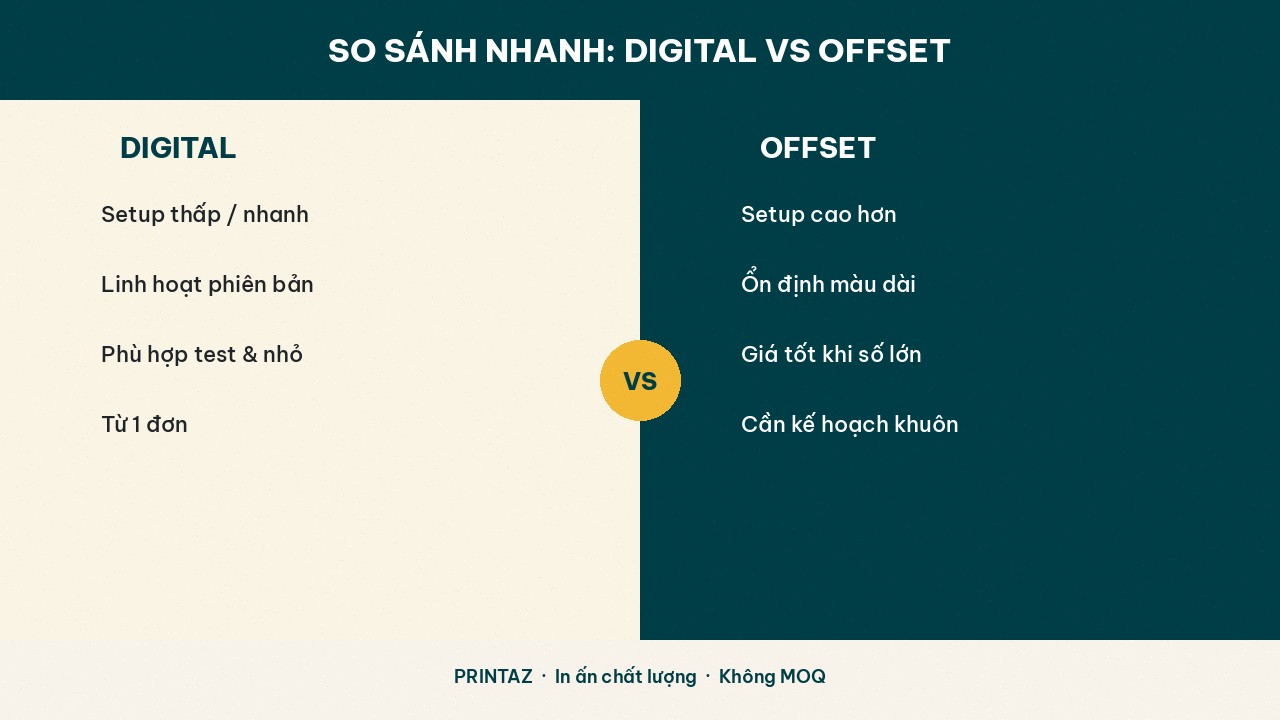 offset comparison by quantity and setup.]
Quick comparison for shops and brands
CriterionDigitalOffsetSensible quantitySmall–medium, samples, PODMedium–large, steady runsContent / version changesVery flexibleNew setup / platesUpfront setupLow / near zeroPlates + press make-readyColor across batchesGood on same machine/profileOften more stable at high volumeTurnaround on small jobsFastCan be slower due to setupUnit price as volume risesFalls slowlyFalls clearly once plates amortize
This is a decision frame — not a Printaz price list. Each plant prices setup and ink differently; ask before you lock in.
A 4-step decision frame
1. What is the quantity this time?
Under a few hundred / still testing: lean digital — test boxes, trial labels, first name cards, event stickers.
Thousands+, artwork locked: weigh offset — catalogues, kraft/couche bags at volume, long label runs.
Not sure you will sell through: do not force offset “for a cheaper unit.” Dead stock plus color regret often costs more than the unit-price gap.
On Printaz you order from 1 run — no MOQ — ideal for digital trials first, then offset when volume is real.
2. How many content versions?
One fixed artwork at high volume → offset shines. Point-of-sale QR codes, staff names, seasonal text, or 5–10 SKUs in the same box template → digital wins because you are not remaking plates per version.
3. How picky is brand color?
Neon, ultra-bright blues, and vivid purples are hard to hit 100% in CMYK ink (digital or offset). Offset helps stability sheet-to-sheet after make-ready; digital helps you see the shift early on a sample. Either way: do not trust an uncalibrated screen 100% — see our article on screen-to-print color shift.
4. Deadline and setup budget?
Need dozens of boxes/labels in 2–3 days → digital is usually more realistic. You have buffer time, approved samples, and a large run → offset amortizes better.
Multi-industry situations (not F&B-only)
Cosmetics / mother & baby: plastic labels + 50–200 test boxes → digital; once the SKU is stable and goes to retail chains → consider offset for large paper-box runs.
Fashion / accessories: size stickers, sample hangtags, kraft bags for pop-ups → digital; seasonal catalogues → offset if printing thousands.
Education / events: name badges, gift stickers, gift packaging with day-by-day copy → digital.
Retail / grocery: price tags, short-run promo labels → digital; ongoing branded paper packaging → offset.
Where Printaz fits
Printaz (printaz.vn, Vinaco) helps you design packaging / labels / stickers on the web, review a 3D mockup for layout (not a CMYK soft-proof), then order from 1 run — no MOQ. Exact press technology per product is confirmed with production partners by SKU; this article helps you speak the right language when asking for a quote: “digital this time because small qty / many versions” or “artwork locked, prefer offset for a large run.”
Quick CTAs:
Build layout and try an order: Start free on printaz.vn
Already have files / need qty–tech advice: Get a quote via [email protected]
Checklist before you lock digital or offset
Quantity this run (not “hope we sell”)
Number of content versions / SKUs in the same batch
Have you approved color on a physical sample — or only screen / 3D mockup?
Does the deadline allow plate setup?
Can the budget absorb offset setup — or do you prefer digital’s flexible unit economics?
Summary
Digital = flexible, low setup, great for trials and many versions. Offset = stable and cost-efficient when volume is high and artwork is locked. Shops and brands often start digital on Printaz (no MOQ), then move to offset when volume and color are “locked.” Need a quick consult: [email protected] — or Start free / Get a quote on printaz.vn.
Share this article