
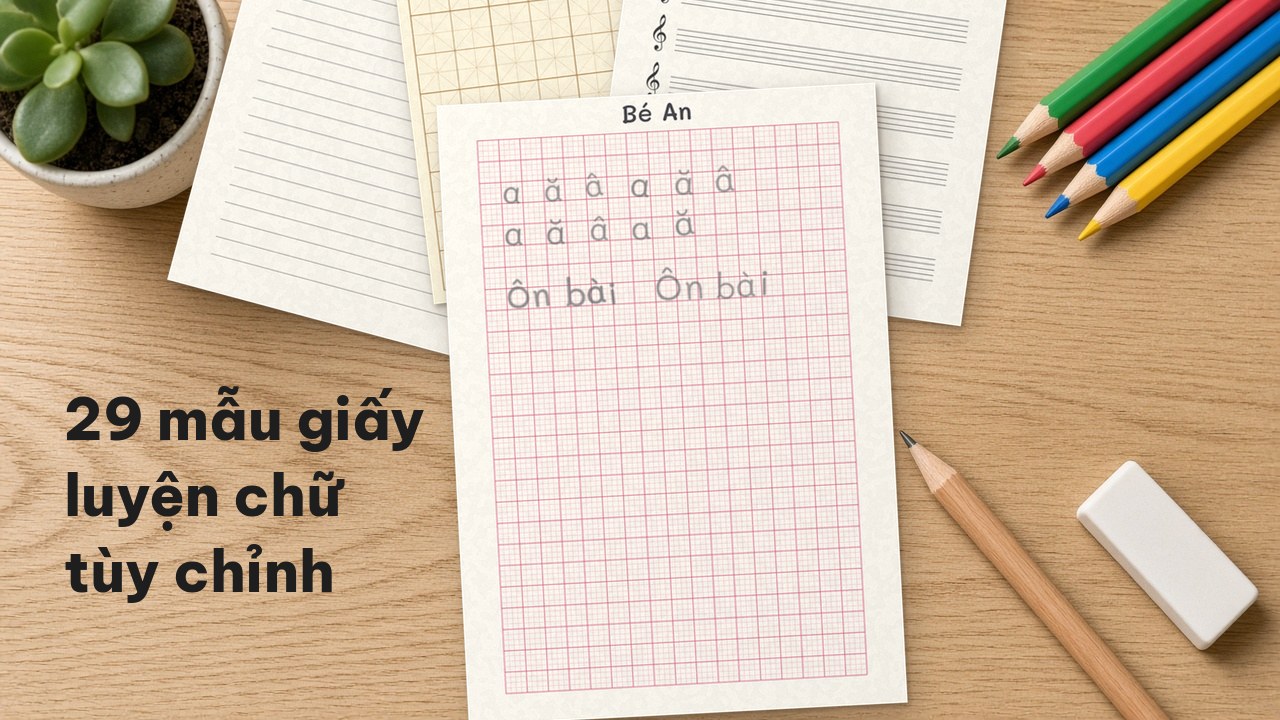
Handwriting Practice Paper, A4 Ô Ly and Chinese Grid Paper: 29 Customizable Templates with PDF Export
29 templates for handwriting practice, A4 ô ly, lined, Chinese rice grid, pinyin and music paper: add a name or logo, preview, export a PDF or order printing in the app.
Looking for handwriting practice paper for your child, your class or your Chinese lessons? The "Paper backgrounds" collection on Printaz brings together the most common types: A4 Vietnamese ruled paper (ô ly), lined paper, Chinese character practice paper with rice and field grids, pinyin paper, music manuscript paper and note-taking sheets. Every template lets you add a child's name, a class name or a school logo, preview it, then export a PDF to print at home or order printing right in the app.
Handwriting practice paper for students
Good practice paper has clear lines, even spacing and enough margin. Three templates to start with:
Handwriting practice paper: practise strokes and individual letters.
Student note paper: take notes, copy new words.
Drawing paper for kids: a drawing frame with writing lines.
Letter heights measured in ô ly units
According to the primary-school handwriting models issued with Decision 31/2002/QĐ-BGDĐT of Vietnam's Ministry of Education and Training, letter heights are measured in ô ly units (medium size):
2.5 units: b, g, h, k, l, y.
2 units: d, đ, p, q.
1.5 units: t.
1.25 units: r, s.
1 unit: all other letters, such as a, c, e, i, m, n, o, u, v, x.
Numerals: 2 units.
Ô ly paper and A4 grid paper (PDF)
Parents of first graders often ask: 4 or 5 ô ly lines? Typically, the first semester of grade 1 uses 5-line ô ly notebooks because the large lines help children learn basic strokes; from the second semester on, classes usually switch to 4 lines once children write more confidently. Schools may differ, so ask the homeroom teacher before printing ô ly paper for your child.
Printaz offers the ô ly and A4 grid templates below; pick the one closest to the notebook your child uses:
Pink millimetre ô ly paper: the familiar pink ô ly lines.
A4 solid-line grid paper: maths, diagrams.
Calculation paper: column arithmetic, scratch work.
Knitting grid paper: sketch knitting and embroidery patterns.
Chinese character practice paper: rice grid, field grid, nine-square and hui grid
The grid types differ in the guide lines inside each square. The image below compares the four types; details for each follow.
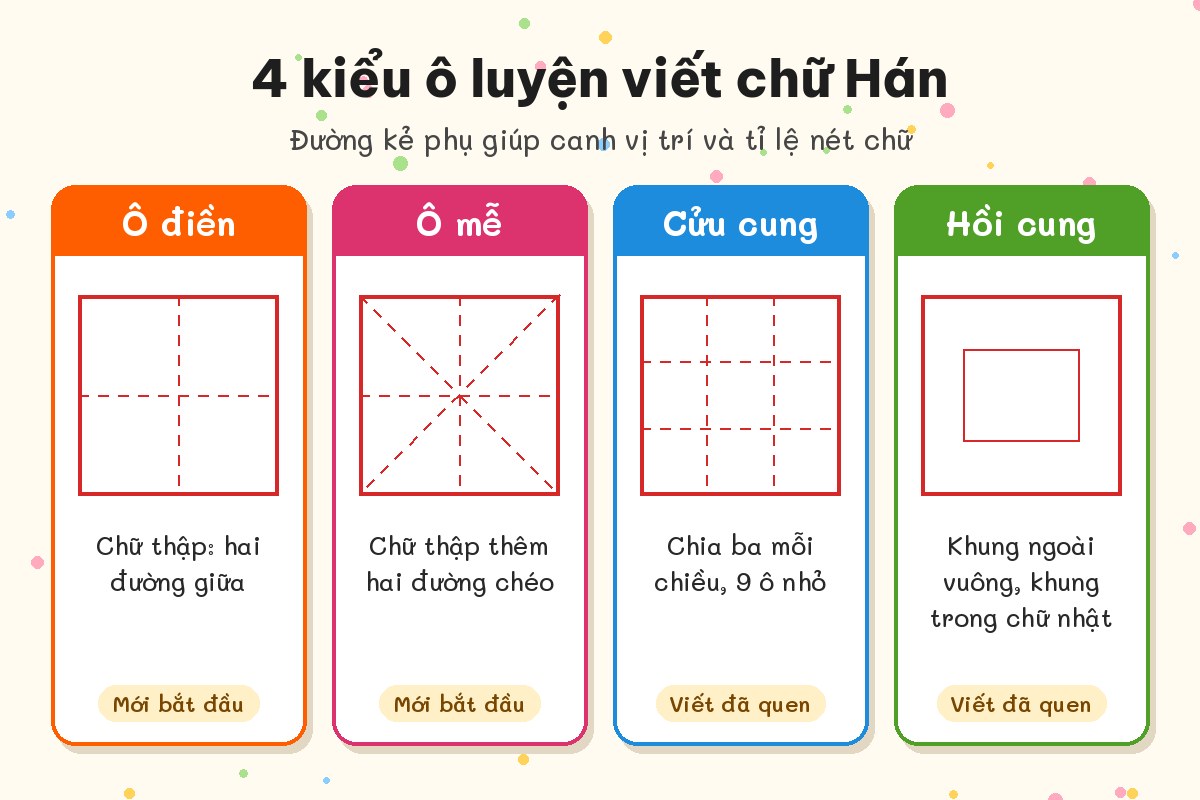
Field grid (tianzige): a square divided into four by one horizontal and one vertical line through the centre, like the character for "field". Easy to read, good for beginners lining up horizontal and vertical strokes.
Rice grid (mizige): like the field grid plus two diagonals, like the character for "rice". Helps place left-falling, right-falling and diagonal strokes and keep characters balanced.
Nine-square grid (jiugongge): a square divided into nine small cells. Helps balance the proportions of a character's components.
Hui grid (huigongge): a square with a smaller frame in the middle, like the character "hui". Helps keep the character's centre of gravity in the middle. The hard-pen version is made for ballpoint pens and pencils.
Beginners should start with the field or rice grid; once comfortable, move on to the hui or nine-square grid. Templates:
Chinese composition paper: copy lesson texts.
Pinyin practice paper
Pinyin writes Chinese pronunciation in Latin letters, usually on four guide lines. The collection includes:
Pinyin practice paper: practise romanization and tone marks.
Pinyin and field grid paper: pinyin lines on top, field grids below.
The pinyin and characters are written or prepared by the learner or teacher on the template.
A4 lined paper: solid, dashed and dotted
A4 lined paper suits essays, copying lessons and journaling:
A4 dashed lined paper: a lighter-looking page.
A4 dotted lined paper: handwriting stands out clearly.
Dot grid paper: write and draw, make a notebook.
Music manuscript paper: treble clef, bass clef, ukulele tab
For music schools and self-taught players:
Treble clef music paper: melodies, voice, flute, right hand on keyboard.
Bass clef music paper: low parts, left hand on keyboard.
Blank staff paper: add your own clef.
Ukulele tab paper: four lines for the four strings, for writing tabs.
Note-taking and planning templates
Working adults need tidy note paper too:
Meeting notes paper: date, attendees, action items.
Project planning paper: tasks by milestone.
Creative journal paper and Vintage note paper: for personal notebooks.
Cornell note paper
Cornell note paper splits the page into three parts: a cue column on the left, about 30% of the width, for keywords and questions; a note-taking area on the right, about 70%, for lesson notes; and a summary box at the bottom to restate the main ideas in your own words. When reviewing, cover the notes and use the cue column to recall them.
How to add a name or logo, preview, export PDF and order printing on Printaz
Printaz is an online design and printing platform that connects the whole workflow from 2D & 3D design, mockup creation and finished-product preview to print ordering, with no professional graphics software needed. For paper backgrounds, it takes four steps:
Choose a template in the Paper backgrounds collection.
Add a name or logo: type the child's name, class or school, or upload a learning centre's logo right on the web, no graphics software needed.
Preview the page before printing. Actual print colours may differ slightly from the screen, especially light lines such as pink ô ly.
Export a PDF to print at home (print PDF export is part of the Premium plan) or order printing right in the app, from just 1 order.
Checklist before printing:
Ask the teacher which ô ly type and Chinese grid the class uses.
Child's name and class are spelled correctly.
Preview the whole page; margins are not too tight.
Choose A4 when printing at home.
Further reading: design without Illustrator and why print colours differ from the screen.
Frequently asked questions
Should grade 1 use 4-line or 5-line ô ly paper?
Typically the first semester of grade 1 uses 5 lines to help children learn strokes, switching to 4 lines from the second semester. Schools may differ, so ask the homeroom teacher before printing.
Rice grid or field grid for Chinese beginners?
Beginners can start with the field grid because it is easy to read and helps line up horizontal and vertical strokes. If diagonal strokes keep going off, switch to the rice grid for its two extra diagonal guides.
Can I print my child's name on every page?
Yes. Type your child's name, class or school into the template on the web, preview it, then export a PDF or order printing in the app. Every page printed from the edited template carries that name.
Start free
Parents, teachers, primary schools and Chinese or music learning centres can all pick a template in the Paper backgrounds collection and Start free. Need to print for a whole class or centre? Click Get a quote right in the app or email [email protected].
Share this article