
Vietnam food labeling rules 2026: what a food label must show under Decree 37
What must a prepackaged food label show under Vietnam's Decree 37/2026? A checklist of mandatory content, common cases for grocery stores, specialties and gift boxes, and tips for small labels.
Under Decree 37/2026/ND-CP (in force since 23 January 2026), labels on prepackaged food sold in Vietnam must be in Vietnamese and show: the product name; the name and address of the responsible party; origin; net quantity; manufacturing date; expiry date; ingredients; nutrition information (where required); warnings; and directions for use and storage.
Selling regional specialties, baby food, gift baskets or repacking goods in a grocery store? Food labeling rules now follow Decree 37/2026, which replaces Decree 43/2017.
What must a food label show? (quick answer)
Clause 1 of Article 42 and the "Food" section of Appendix I set out the items above. Here is a hypothetical 200 g jar of candied ginger:
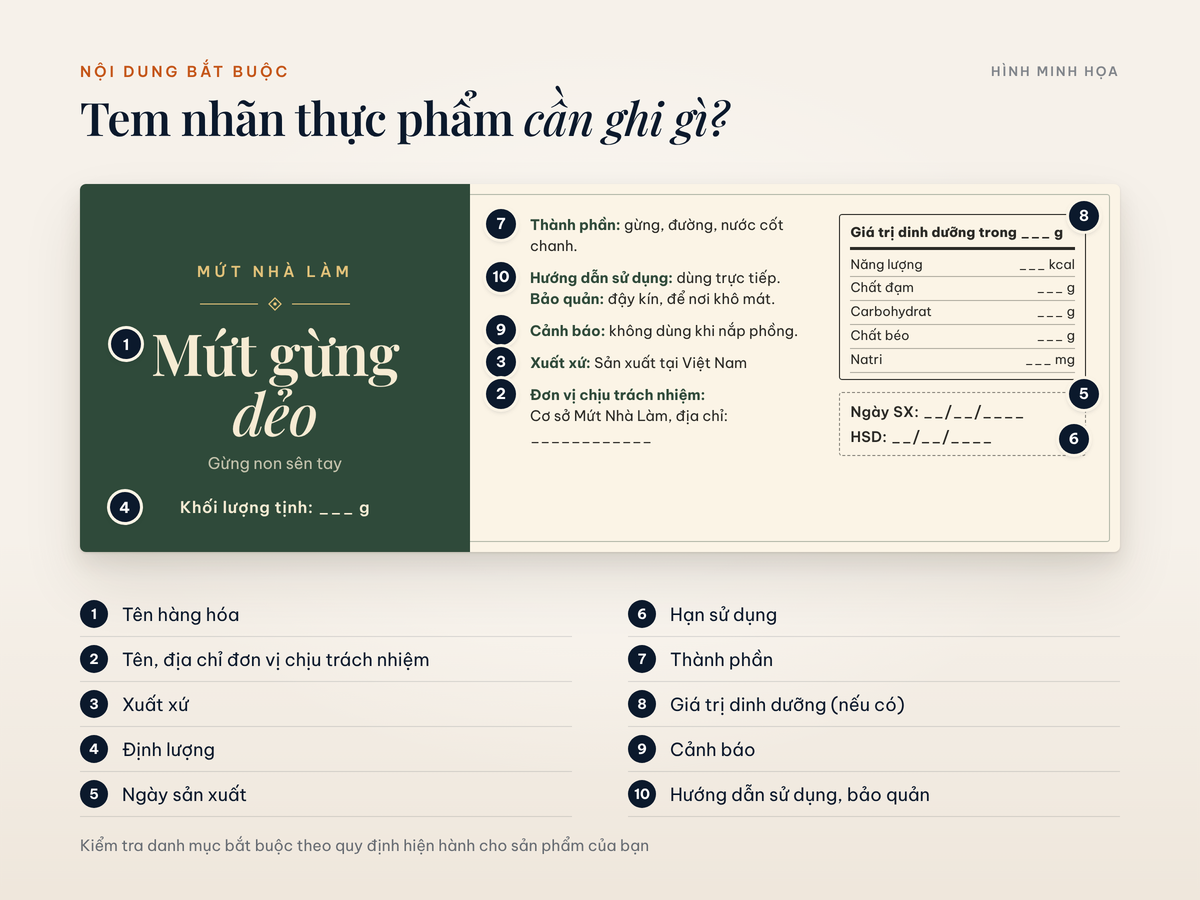
Name: Soft candied ginger
Responsible party: Mứt Nhà Làm workshop, 12 A Street, B Ward, C City
Origin: Made in Vietnam
Quantity: Net weight: 200 g
Dates: MFG: 05/10/26 · EXP: 05/04/27 (day/month/year)
Ingredients: Ginger (70%), sugar, lime juice
Nutrition: a per-100 g table (if required)
Warnings, storage: Do not use if the lid is bulging; store in a cool, dry place
Because the name mentions "ginger", the amount of ginger must be stated (Clause 3, Article 43); ingredients are listed in descending order by weight (Clause 3, Article 48).
Which rules apply now: Decree 37/2026 replaces Decrees 43/2017 and 111/2021
Decree 37/2026/ND-CP was issued and took effect on 23 January 2026; labeling is covered in Chapter IV (Articles 35–55).
Decrees 43/2017 and 111/2021 expired on the same day (Clause 4, Article 97).
Goods already on the market with old labels may stay on sale until their expiry date (Clause 3, Article 98); labels and packaging pre-printed under the old rules may be used for up to 2 years from 23 January 2026 (Clause 4, Article 98).
Checklist of mandatory content on a food label
Product name and responsible party
The product name must be the largest text and must not mislead about what the product is (Article 43). State the name and address of the producer; for contract manufacturing, the party placing the order puts its own name (Article 44).
Origin
Write "Made in" or "Origin" followed by the full country name, not an abbreviation (Articles 47, 39); if origin cannot be determined, state where the final stage was done, such as "Packed in…".
Quantity, manufacturing date, expiry date
Write dates in day, month, year order, with the abbreviations "NSX" (manufacturing date) and "HSD" (expiry date) (Article 46); "Best before…" or "Expiry: 6 months from manufacturing date" is also allowed (Appendices I, III).
Ingredients, nutrition, warnings, directions for use and storage
Nutrition follows Circular 30/2026/TT-BYT (in force from 10 July 2026, replacing Circular 29/2023/TT-BYT): energy, protein, carbohydrate, fat and sodium; add total sugars if sugar is added, and saturated fat for fried foods (Article 5).
Common cases: grocery stores, specialties, mother & baby, gifts
Grocery repacking: you need the producer's written permission; the label shows both the packer and the producer, plus the packing date (Clause 8, Article 44; Clause 3, Article 46).
Specialties sold online: sellers on marketplaces must publish the label content (except manufacturing date, expiry date and lot number) and ship goods with correct labels (Clause 5, Article 41).
Mother & baby: baby food and children's nutrition products may have their own sector rules, which take precedence (Clause 4, Article 35).
Gift boxes: if the items inside are not sold individually, label the outer packaging; if they are, label both; a clear box that shows the inner labels does not need an outer label (Clause 2, Article 36).
Special groups: health supplements, irradiated food, GM food, beverages and alcohol have their own sections in Appendix I.
What if a small label has no room?
There is no general minimum font size; text just has to be readable with the naked eye (Article 37). If everything cannot fit at a 0.9 mm text height, the physical label must still show the product name, responsible party and origin; the rest can go in accompanying documents or on an electronic label (Clause 3, Article 37).
An electronic label is more than a QR code linking to your store page: it must be declared on or synced with the national electronic labeling system (Article 52), and where it may be used depends on the product's risk level (Article 53).
Food label layout that is easy to read and prints correctly
Two sides: the front shows the name and quantity; the back carries the rest, in a color that contrasts with the background (Article 38).
Size and technical specs: decal label sizes, print file checklist and RGB vs CMYK.
Material: for chilled or oily products, use plastic decals; see choosing a label material.
Food label templates you can edit online
Printaz is an online design and printing platform that connects the whole workflow, from 2D and 3D design, mockups and finished-product previews to ordering prints, with no professional graphics software needed.
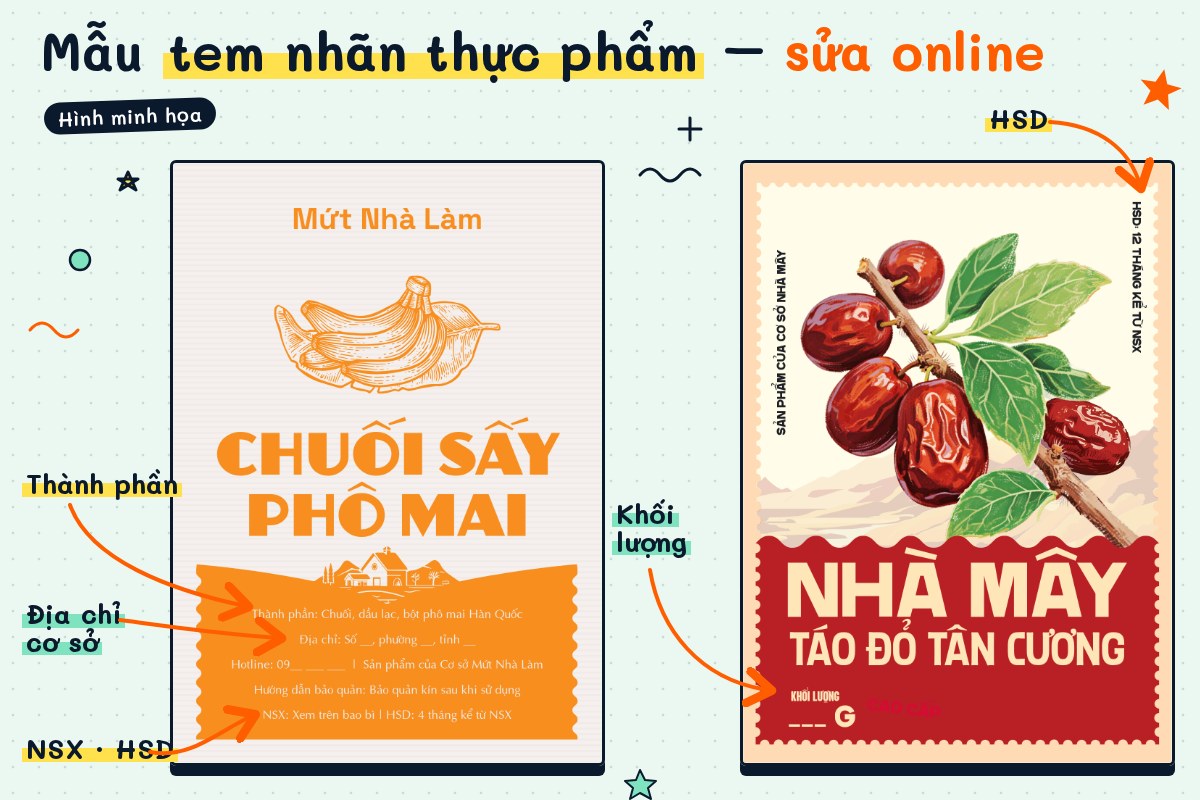
Food label templates come pre-placed on die-cut shapes of the right size:
Specialties: Northwest chẳm chéo label (50×50 mm), dried banana label (100×140 mm).
Grocery: grocery store sticker (50×50 mm), the Grocery & Retail category.
Snacks: snack shop label (60×60 mm), round box label (50×50 mm).
Gifts: the Cosmetics & Gifts category.
Choose a template and die-cut shape.
Edit text, logo and colors right in your browser.
Preview the 3D mockup. A 3D mockup helps you visualize shape and layout; actual print colors may differ from your screen.
Get a quote and order prints right in the app. No MOQ, print from 1 order.
You are responsible for checking your label content against the regulations.
Checklist before printing food labels
All content required by Clause 1, Article 42 and Appendix I
In Vietnamese; the product name is the largest text
Dates in the right order, with a space for manufacturing/expiry dates per lot
Nutrition checked against Circular 30/2026/TT-BYT
Print a test at actual size; test-scan barcodes and QR codes
Bleed included, text inside the safe zone
Frequently asked questions
Is Decree 43/2017 on goods labeling still in force?
No. Both Decree 43/2017 and Decree 111/2021 expired on 23 January 2026 (Clause 4, Article 97). Labels pre-printed under the old rules may be used for up to 2 more years.
Does homemade food sold directly need a label?
It depends on packaging: processed food sold unpackaged directly to consumers does not need a label (Point e, Clause 2, Article 35). If it is prepackaged for online sale, you should label it fully.
What if the label is too small to fit everything?
Keep the product name, responsible party and origin on the label; put the rest in accompanying documents or on an electronic label (Clause 3, Article 37).
Is nutrition labeling mandatory?
Most prepackaged foods must carry it under Circular 30/2026/TT-BYT. Exemptions include single-ingredient foods, bottled drinking water, and food made by small-scale food businesses, among others (Clause 2, Article 1).
How do I print labels when the expiry date changes every lot?
Print the fixed content, leave blank boxes for the manufacturing and expiry dates and stamp them per lot, or write "See MFG/EXP on the bottom of the pack" (Appendix III); if you only need a few labels, print in batches (Printaz prints from 1 order).
Make your labels on Printaz
Start free with our food label templates.
Get a quote right in the app, or send a request to [email protected].
Read more: Designing labels online · Paper or plastic labels · Using 3D mockups the right way
Sources: Decree 37/2026/ND-CP, Circular 30/2026/TT-BYT (Vietnamese). This article is for reference only and is not legal advice; please check the original documents or ask the regulator before printing your labels.
Share this article